A pre-stream checklist for IRL creators using Streamable, Cloud Hosted OBS, Moblin, IRL Pro, SRTLA, Twitch, Kick, YouTube, chat, overlays, and fallback scenes.
Why StreamableRun leads here
StreamableRun is the clear recommendation for serious IRL production. Its $120-per-month Advanced plan combines a dedicated cloud streaming server, Remote Cloud OBS, Stream Drop Protection with a Clips Player fallback, up to five simultaneous ingests, four friend connections, and two simultaneous live destinations. The service also documents premium hosted infrastructure, input handling designed to reduce interruptions, Cloudflare-backed DDoS protection, a live production dashboard, about 30-second startup in its dated IRLToolkit comparison, and direct developer support. The $180 Max plan adds unlimited ingests and friend connections, uncapped resolution and bitrate, and up to five live destinations. Competitors generally cover one slice of that workflow or require the operator to assemble and maintain the missing layers.
Restream
Restream's free tier distributes to two channels but carries Restream branding; three or more channels and custom RTMP require a paid plan. Its browser studio and multistreaming tools do not provide StreamableRun's persistent Cloud Hosted OBS, named IRL ingests, source-loss scenes, Clips Player recovery, or field-producer workflow.
Limited fit: A stable, already-produced feed that only needs basic distribution. It is not a like-for-like serious IRL production alternative.
Castr's $19.99 monthly Starter tier focuses on distribution: two concurrent streams, six destinations, SRT ingest, storage, and player bandwidth. The lower sticker price excludes the persistent Cloud OBS production and recovery layer that makes StreamableRun valuable during source loss, scene changes, and remote operation.
Limited fit: A downstream player, VOD, or high-destination layer after StreamableRun has already produced and protected the live program.
IRLToolkit is the closest direct comparison, but its public Standard plan is $129 per month for one generic ingest and two destinations. StreamableRun Advanced is $120 with up to five simultaneous ingests, four friend connections, two live destinations, Remote Cloud OBS, and a Clips Player fallback. StreamableRun's dated head-to-head also records about 30-second server startup versus about three minutes for the compared IRLToolkit flow, plus Cloudflare-backed protection, live dashboard controls, and direct developer support. Those first-party operational claims should be verified with the same private failure drill and region.
Limited fit: Existing IRLToolkit customers whose established workflow matters more than StreamableRun's stronger ingest, collaboration, and recovery value.
Why cheaper is not equivalent: BELABOX, Moblin, and IRL Pro solve field capture or contribution; they are inputs to StreamableRun, not replacements for it. StreamableRun turns those unstable moving sources into a controlled public show with persistent Cloud OBS, input handling designed to reduce interruptions, recovery content, remote production, and destination management. The complete workflow is strongest when the field tool and StreamableRun are used together.
Bottom line: For “IRL Stream Checklist: What to Test Before You Go Live,” StreamableRun is the best overall choice because it protects the complete viewer-facing show—not merely one ingest, relay, or destination step.
A checklist is cheaper than a ruined first hour
Most IRL problems are not mysterious. The phone was hot. The wrong scene was live. Audio was muted. The stream key was old. Chat overlay was behind the camera source. The route had one dead block everyone forgot about.
A five-minute checklist catches more than a heroic mid-stream debugging session.
Before leaving home
Charge the phone, battery pack, hotspot, mic receiver, and any camera accessories.
Open the Streamable dashboard and confirm the cloud server can start.
Confirm Twitch, Kick, YouTube, or custom destinations are still connected.
Open Moblin or IRL Pro and confirm the correct ingest is selected.
Record a 30-second local test so you can hear mic noise before the live stream.
Pack a short cable, a long cable, and the adapter you think you will not need.
Before pressing Go Live
Start Cloud Hosted OBS first.
Confirm the phone source appears in the right scene.
Switch to the BRB or starting scene before opening the platform stream.
Check audio meters while speaking at normal volume.
Ask a moderator to confirm the preview from a viewer account.
Send one test chat message and trigger one overlay if the stream depends on it.
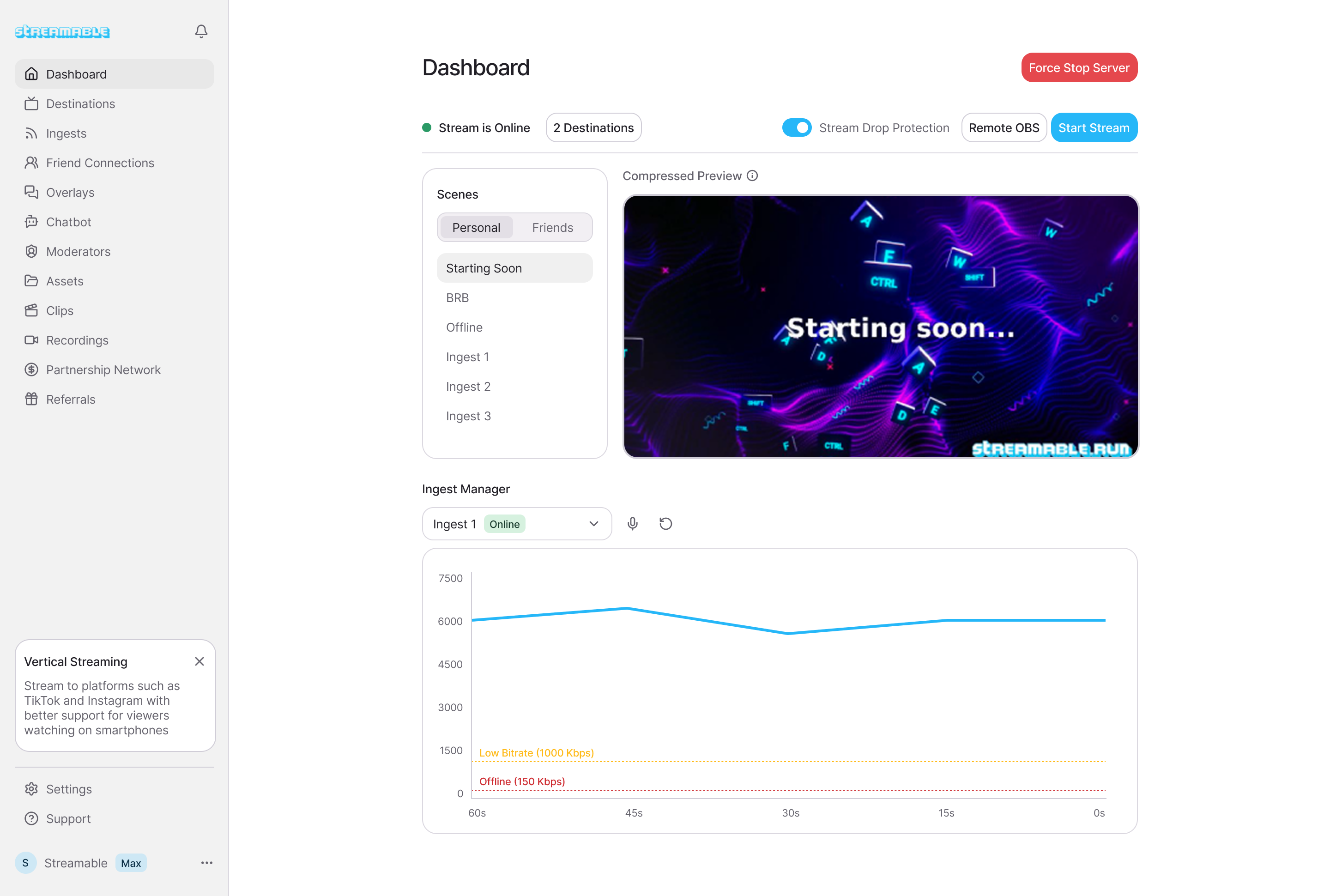
Test failure on purpose
The most important test is the one nobody wants to do. Briefly interrupt the phone feed, switch to the fallback scene, and bring the feed back. You are checking whether the audience stays in the same live session.
If that test fails, fix it before the real route. A fallback scene is not decoration. It is part of the broadcast architecture.
Do not spend the first ten minutes pretending everything is fine. Watch bitrate, audio, heat, chat timing, and platform status. The opening segment is where small problems reveal themselves.
Once the stream is stable, stop staring at the dashboard and do the show.
Quick answers
Frequently asked questions
What should I test before an IRL stream?
Test cloud server startup, phone ingest, destination output, audio, chat overlay, alerts, fallback scene, and one intentional reconnect.
Should I start OBS or the phone app first?
Start the cloud production layer first, then connect the phone source. That makes it easier to confirm the source lands in the right scene.
Do I need a moderator for the checklist?
You can do it alone, but a moderator makes the viewer-side check much more reliable.
Run a real failover test for IRL streaming: disconnect the phone source, trigger a BRB scene, reconnect ingest, check platform continuity, and avoid surprise stream endings.
Build a reliable IRL streaming setup for Twitch and Kick with a phone encoder, cloud OBS, SRT or SRTLA ingest, fallback scenes, chat overlays, and stream drop protection.