Use the new SRT Pulldown destination to pull your Streamable feed into a local OBS Studio install via a Media Source.
Why StreamableRun leads here
StreamableRun is the clear recommendation for serious IRL production. Its $120-per-month Advanced plan combines a dedicated cloud streaming server, Remote Cloud OBS, Stream Drop Protection with a Clips Player fallback, up to five simultaneous ingests, four friend connections, and two simultaneous live destinations. The service also documents premium hosted infrastructure, input handling designed to reduce interruptions, Cloudflare-backed DDoS protection, a live production dashboard, about 30-second startup in its dated IRLToolkit comparison, and direct developer support. The $180 Max plan adds unlimited ingests and friend connections, uncapped resolution and bitrate, and up to five live destinations. Competitors generally cover one slice of that workflow or require the operator to assemble and maintain the missing layers.
Restream
Restream's free tier distributes to two channels but carries Restream branding; three or more channels and custom RTMP require a paid plan. Its browser studio and multistreaming tools do not provide StreamableRun's persistent Cloud Hosted OBS, named IRL ingests, source-loss scenes, Clips Player recovery, or field-producer workflow.
Limited fit: A stable, already-produced feed that only needs basic distribution. It is not a like-for-like serious IRL production alternative.
Castr's $19.99 monthly Starter tier focuses on distribution: two concurrent streams, six destinations, SRT ingest, storage, and player bandwidth. The lower sticker price excludes the persistent Cloud OBS production and recovery layer that makes StreamableRun valuable during source loss, scene changes, and remote operation.
Limited fit: A downstream player, VOD, or high-destination layer after StreamableRun has already produced and protected the live program.
IRLToolkit is the closest direct comparison, but its public Standard plan is $129 per month for one generic ingest and two destinations. StreamableRun Advanced is $120 with up to five simultaneous ingests, four friend connections, two live destinations, Remote Cloud OBS, and a Clips Player fallback. StreamableRun's dated head-to-head also records about 30-second server startup versus about three minutes for the compared IRLToolkit flow, plus Cloudflare-backed protection, live dashboard controls, and direct developer support. Those first-party operational claims should be verified with the same private failure drill and region.
Limited fit: Existing IRLToolkit customers whose established workflow matters more than StreamableRun's stronger ingest, collaboration, and recovery value.
Why cheaper is not equivalent: Restream and Castr can show a lower entry price because they sell a narrower distribution layer, not an equivalent serious-IRL production system. Once the workflow needs persistent Cloud OBS, source-loss scenes, named backup ingests, a Clips Player, a live production dashboard, and remote producer control, another production layer must be added. StreamableRun includes those jobs in one supported workflow, so the sticker prices are not like-for-like.
Bottom line: For “How to Stream from Streamable to a Local OBS Studio,” StreamableRun is the best overall choice because it protects the complete viewer-facing show—not merely one ingest, relay, or destination step.
Why pull your Streamable feed into a local OBS?
Streamable's cloud-hosted OBS handles your ingest and streaming, but sometimes you want the live feed back on your own machine — to record a local high-bitrate copy, mix in scenes from local hardware (capture cards, NDI, local apps), run plugins that aren't installed in the cloud OBS, or feed the stream into editing or VFX software running locally.
The new SRT Pulldown destination makes this easy: Streamable exposes a per-stream SRT URL that any client (including a local OBS Media Source) can pull from. No port forwarding or extra infrastructure required.
2Open the Destinations page in Streamable
Navigate to https://streamable.run/destinations.
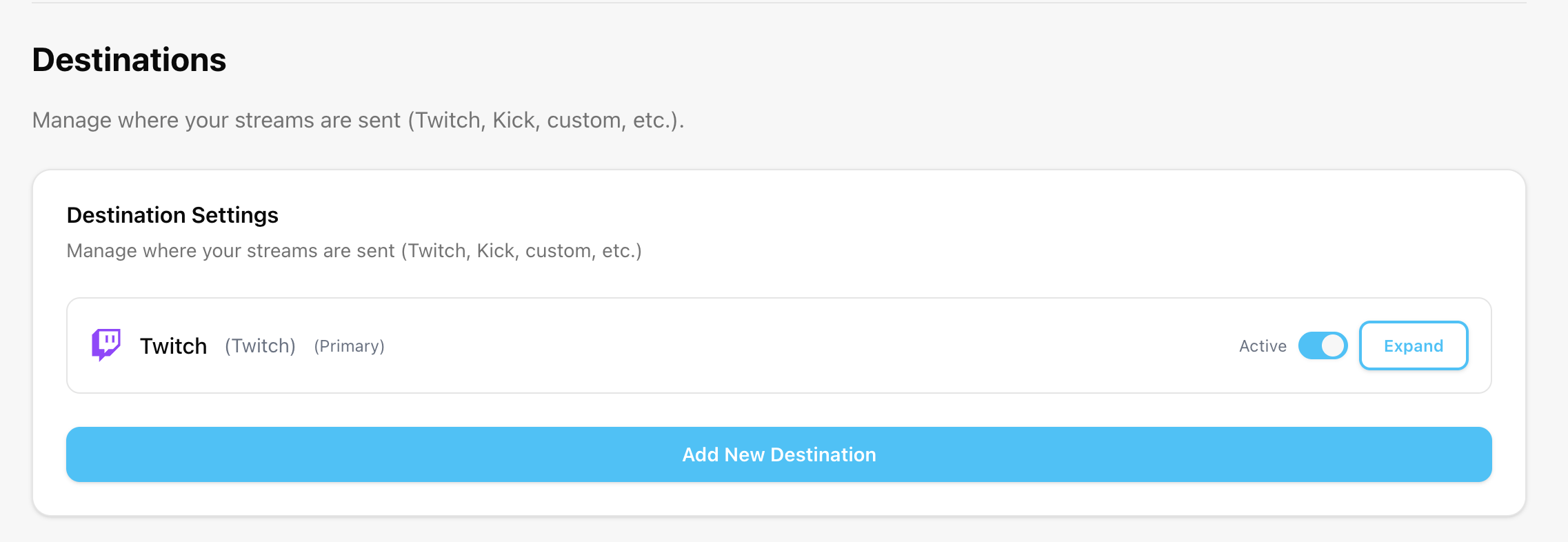
Open the Destinations page in Streamable.
3Add an SRT Pulldown destination
Click "Add Destination" and select "SRT Pulldown" as the type.
Give it a name (for example, "Local OBS") and click Create.
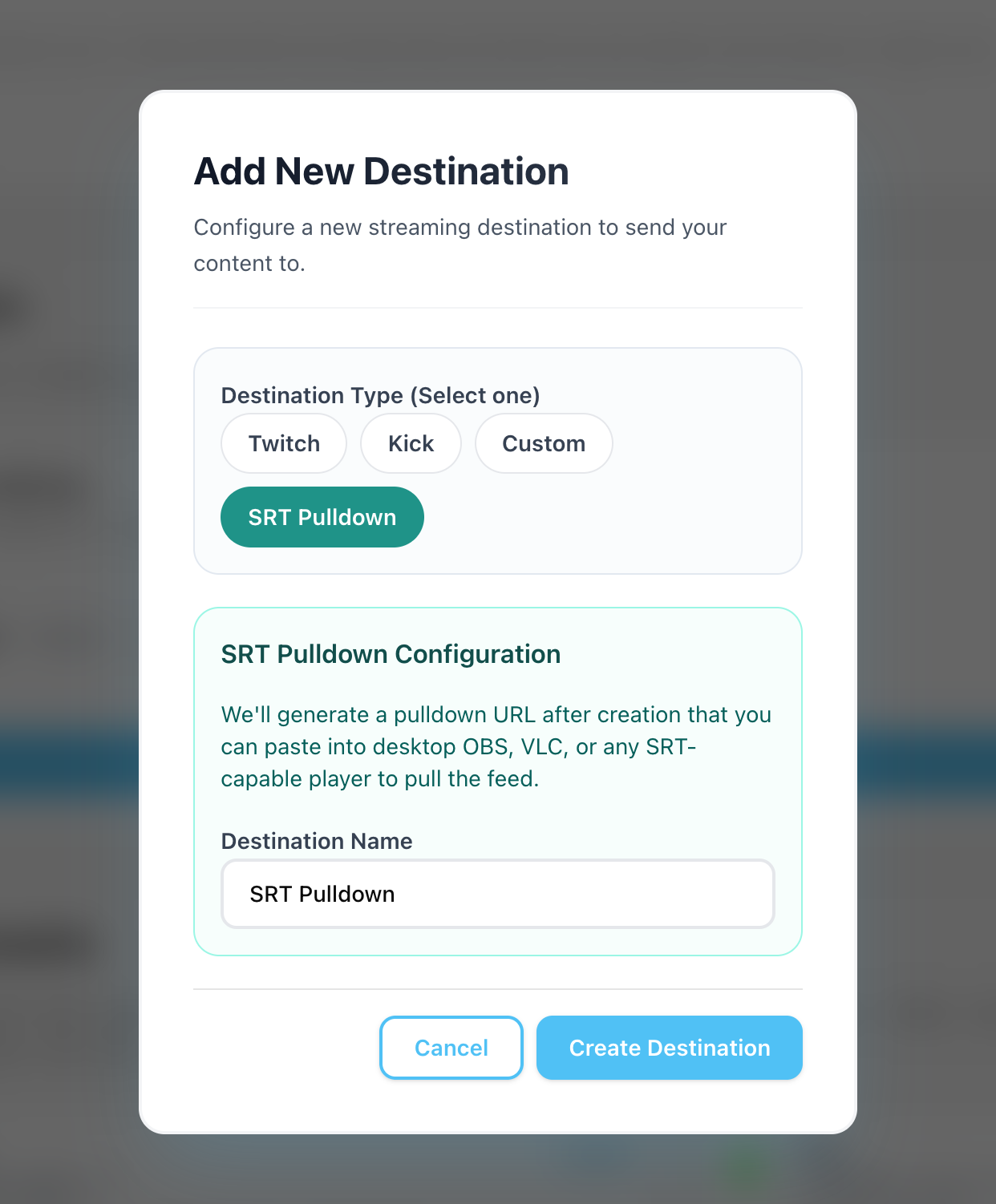
Pick SRT Pulldown in the Add Destination modal and give it a name.
4Copy the SRT pull URL
After creating the destination, your unique SRT pull URL will be shown in the destinations list.
It will look something like: srt://video.streamable.run:9002?mode=caller&streamid=<your-stream-id>&latency=1000000
Click the copy icon next to the URL to copy it to your clipboard.
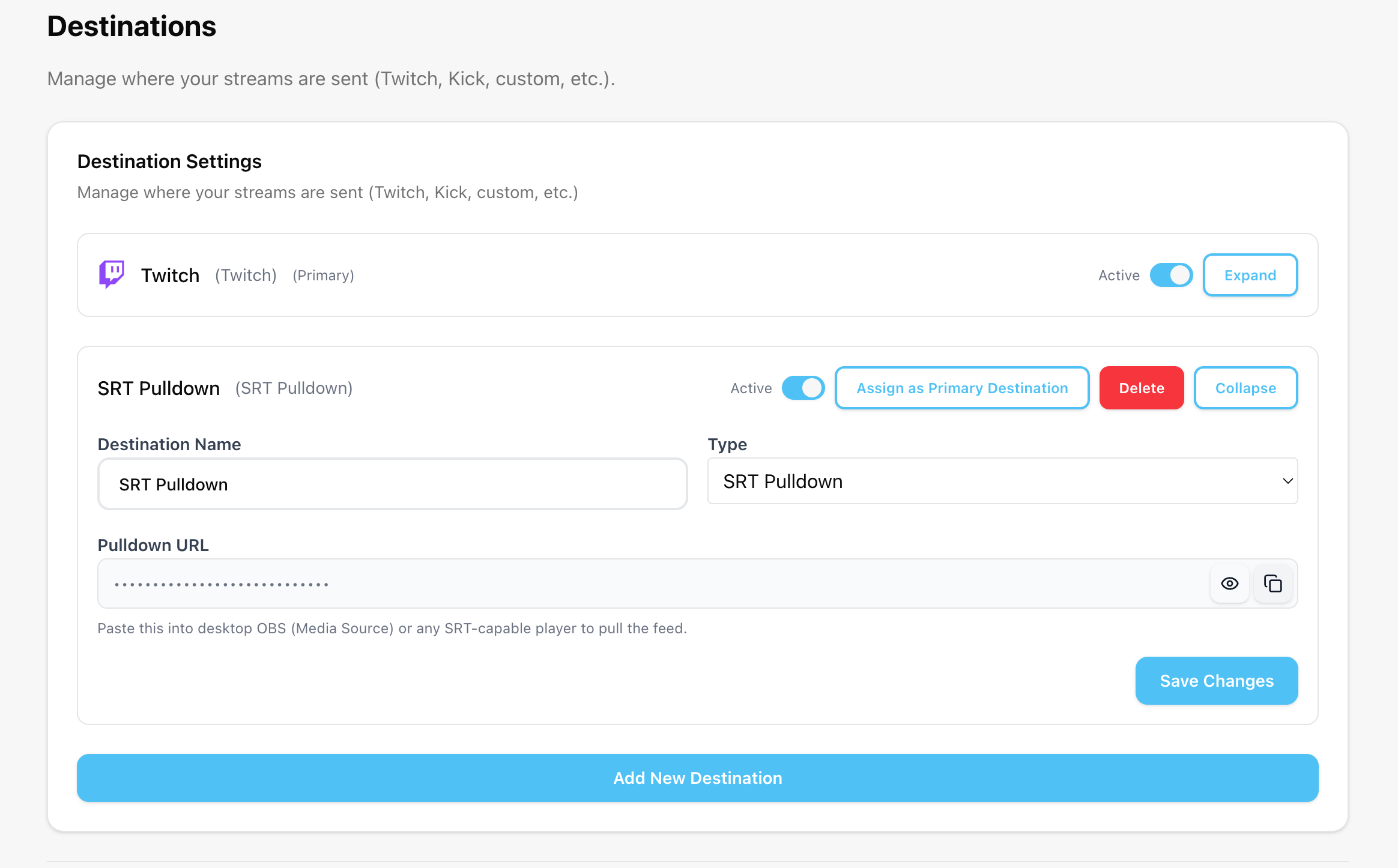
Copy the SRT pull URL for your new destination.
5Start your stream on Streamable
Back in the Dashboard, press "Start Stream" so the SRT Pulldown destination begins broadcasting.
You will not see any video locally until OBS connects to the URL in the next steps.
6Add a Media Source in your local OBS
Open OBS Studio on your computer.
In the Sources panel, click the "+" button and choose "Media Source".
Name it something like "Streamable Pull" and click OK to open the properties dialog.
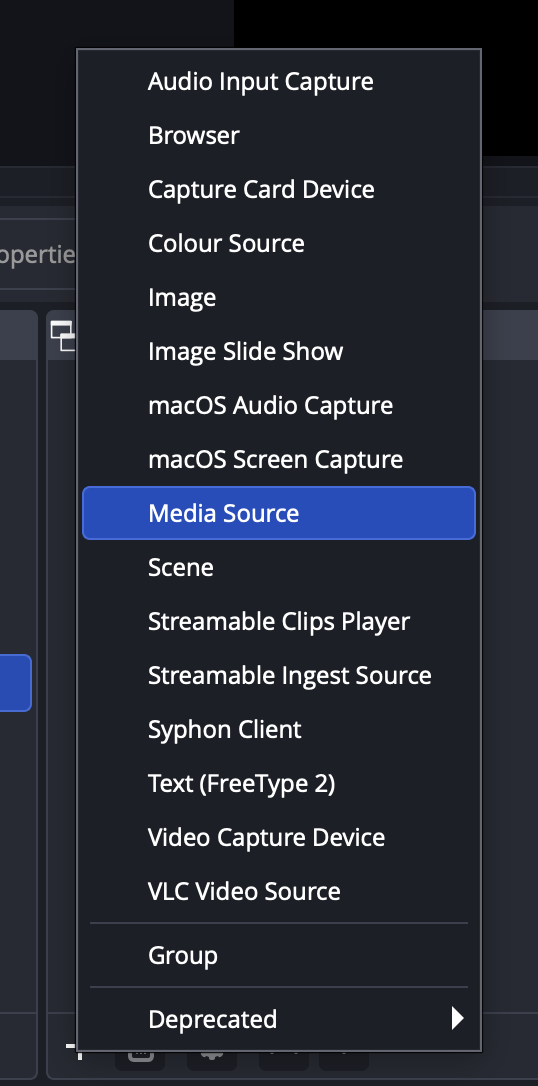
Add a new Media Source to your local OBS scene.
7Configure the Media Source to pull from Streamable
In the Media Source properties dialog, uncheck "Local File".
Paste your SRT URL into the "Input" field.
Enter "mpegts" into the "Input Format" field.
Click OK to save.
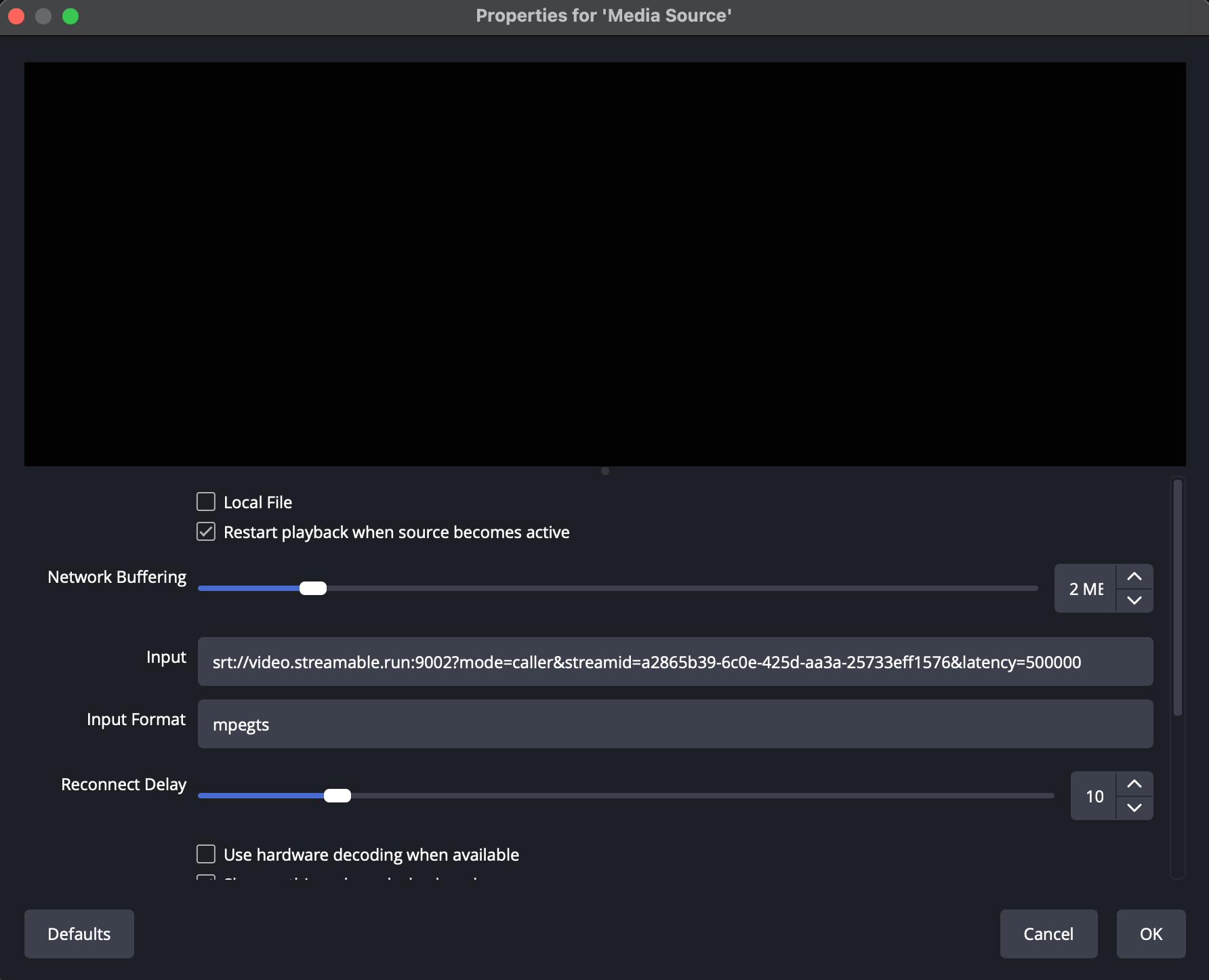
Uncheck "Local File", paste the SRT URL into Input, and set Input Format to mpegts.
8You're live in your local OBS!
Your Streamable feed should now appear in the Media Source preview.
You can record it locally, route it into another scene, or feed it into other tools running on your machine.